
Werribee’s family homeowners — whether they’ve just settled on a new estate home or bought into the established streets near Werribee Park — share a common situation: they have a property they’ve made a significant investment in, hardware that was installed by someone else to someone else’s specification, and a general sense that they should probably do something about security without a clear framework for what actually matters.
This is that framework. Security upgrades family home Werribee homeowners actually need, ranked by the impact they produce on the security outcomes that matter in this specific suburb.
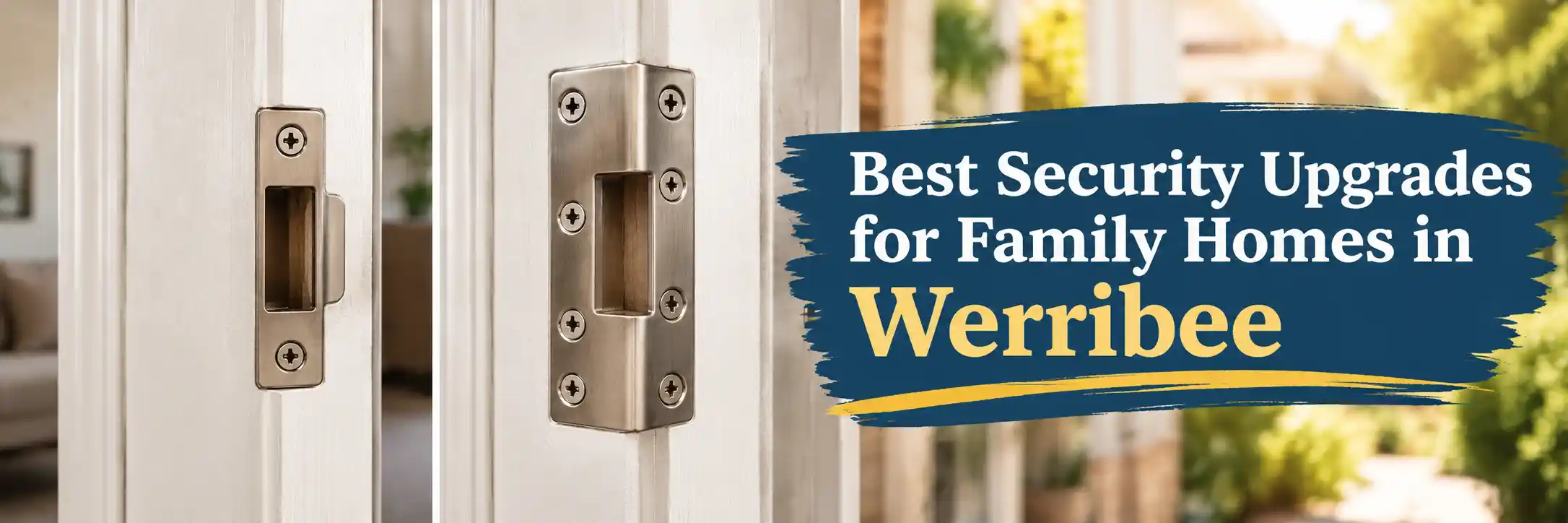
Upgrade 1: Reinforced Strike Plate — Highest Return, Lowest Profile
If there’s one upgrade that produces the most security improvement per dollar in a Werribee family home, it’s the strike plate. Not the lock. Not an alarm. The strike plate.
Here’s why: most residential break-ins don’t defeat the lock. They defeat the frame. A shoulder charge or kick at the lock position doesn’t need to overcome the cylinder — it needs to pull the strike plate screws out of the timber. Standard builder-grade strike plates in Werribee estate homes use screws of 30-35mm into surface timber. Under a sustained kick, these pull out in seconds.
A reinforced strike plate — heavier gauge steel, extended screw positions — secured with 75mm+ screws that pass through the door jamb and anchor into the structural stud behind it changes the load path entirely. The force now has to defeat the house’s structural framing, not a few short screws in surface timber. The difference in forced-entry resistance is substantial, the visual footprint is zero, and the cost is minimal.
This upgrade applies equally to new estate homes (which virtually always have builder-grade plates) and older Werribee homes (where the original plates may be corroded, painted over, or with screws that have lost their grip after decades).
Pro Tip:
Test your current strike plate before spending on anything else. With the deadlock engaged, push firmly against the door at the lock position with your shoulder — not enough to damage anything, enough to feel whether the door flexes. A properly anchored strike plate produces no flex. One secured with short screws in surface timber allows the door edge to move noticeably. That movement tells you where your forced-entry vulnerability actually sits.
Upgrade 2: High-Security Cylinder
The cylinder is the part of the lock that the key interacts with. Builder-grade cylinders in Werribee’s estate homes meet the NCC compliance requirement. They don’t meet Australian Standard AS 4145.2’s high-security specification.
What the difference means in practice:
- Anti-pick protection. High-security cylinders use security pin configurations that defeat standard picking tools. Builder-grade cylinders use standard pin stacks without this protection.
- Anti-drill protection. Hardened steel inserts in the cylinder core resist drilling attacks. Most builder-grade cylinders don’t have these.
- Anti-bump protection. Security pin variants that resist the bump key technique. Standard cylinders are vulnerable; high-security cylinders are specifically engineered against it.
- Restricted key blanks. Keys cut to profiles available only through the authorising locksmith — not at any hardware store. This means anyone who briefly held your key during the construction or sales process cannot copy it. Standard builder-grade blanks don’t have this protection.
The cylinder upgrade is usually combined with rekeying — the new high-security cylinder is keyed to new keys, and the construction or previous occupancy history is closed simultaneously. One locksmith visit addresses both.
Upgrade 3: Back Door Deadlock
In Werribee’s family homes — both new estate properties and established homes — the back door is consistently the security gap. The front entry receives hardware attention because it’s the face the home presents to the street. The back entry receives whatever was cheapest to install.
A Werribee family home’s back door often has:
- A keyed lever handle only — no separate deadlock throwing a bolt independently into the strike plate
- The same lever handle grade as the front door, but without the deadlock that was added to the front
- A timber frame with more moisture exposure than the front — laundry proximity, less shelter, more seasonal movement
Adding a quality deadlock to the back door — same specification as the front, with a reinforced strike plate — is the upgrade that most directly addresses the entry point that break-ins actually use in suburban Werribee. The front is locked; the back is where the attempt happens.
Upgrade 4: Garage Connecting Door
Werribee’s estate homes have attached or semi-attached garages as standard. The door between the garage and the house interior is where security gaps concentrate.
Most Werribee homeowners treat this door as internal. It is external: anyone who accesses the garage — through an automatic door with a tripped emergency release, over a side gate, through an unlocked garage door left open briefly — immediately faces this connecting door. If it has only a passage knob, entry into the house from the garage takes seconds.
The connecting door upgrade: a quality deadlock, the same specification as the main entry door, with a reinforced strike plate. The visual impact is minimal — it’s inside the garage. The security impact is direct and significant.
Additionally: automatic garage doors in Werribee estate homes have an emergency release cord that can be tripped from outside through the gap at the door’s header. A release shield — a simple cover over the release mechanism inside the door — prevents this specific entry technique, which is more common than most homeowners realise.
“The security assessment jobs in Werribee consistently surface the same pattern. Front door is well-specified — the builder put a decent product in because it’s visible at inspection. Back door has a lever handle only. Garage connecting door has a passage knob. Strike plate at the front has 30mm screws. Three gaps, none of them requiring sophisticated attacks, all of them addressable in a single visit. The family has been in the house for six months feeling secure, and the actual picture is completely different.”
Upgrade 5: Window Security
Werribee’s new estate homes have aluminium sliding windows as the standard installation. The latches on these windows provide the appearance of security without always providing the function.
The test: with the window closed and latched, push firmly outward at the latch point. The window should not move. In many Werribee estate homes, it does — the latch was installed but not adjusted to provide resistance under load.
Secondary window locks — key-operated pin locks, window stops, hinged wedge locks — address this without requiring window replacement. For ground-floor windows on the sides and rear of Werribee homes (the windows with less street visibility and lower natural observation), these additions are the relevant upgrade.
For Werribee family homes with children: window restrictors that limit opening to 100mm while still allowing ventilation are a safety and security upgrade simultaneously. They prevent falls and prevent window entry.
Upgrade 6: Motion-Activated Lighting
Motion-activated lighting is the security upgrade that costs least and deters most. Residential break-ins concentrate in conditions of low observation and low light. A sensor light that activates on approach to the rear of a Werribee family home changes the risk calculation for any opportunistic attempt.
Effective placement for Werribee homes:
- Covering the full approach to the back door, not just the door itself — the sensor should activate before a person reaches the entry point, not after
- Illuminating any side passage that provides access from the street to the rear
- Covering the garage driveway and the approach to the garage connecting door
In Werribee’s newer estates where houses sit on standard-width lots with side passages between properties, the side passage lighting is particularly relevant. A motion light that illuminates the full passage makes any movement toward the rear visible to neighbours and from the street.
Warning:
For Werribee townhouse residents in OC-governed developments: confirm with your OC before installing external motion lighting or any external fitting. In some Wyndham City Council development zones, external fittings on the common property boundary require OC and potentially council approval. Internal lighting upgrades within the lot don’t have this constraint. Check the OC’s by-laws and your lot’s boundary definition before installing anything externally.
The Wyndham Growth Corridor and Insurance
Werribee’s rapid growth has brought it into an insurance category that some homeowners don’t expect. Premium home and contents insurance policies for Werribee properties — particularly in the newer estates — often include security conditions that specify minimum lock grades, deadlock requirements, and window security standards.
Before the next renewal: review your policy’s security conditions. If the policy requires a deadlock on all external doors and the back door only has a lever handle, that’s a policy condition gap. A claim that involves forced entry through a non-compliant door may be disputed on this basis. The upgrade that addresses the security gap also addresses the insurance gap.
The Sequence That Works
- Strike plate reinforcement on all external entries — highest return, do this first
- Back door deadlock — the gap that break-ins actually exploit
- Garage connecting door deadlock — often missed entirely
- High-security cylinder upgrade combined with rekeying — closes key history and improves specification simultaneously
- Window security on ground-floor non-street-facing windows
- Motion lighting on rear and side approaches